Clark withdraws

Well, like I said the other day, it’s clear Clark is done, and his staff finally counseled him to drop out of the race.  I’m very sad about this, but on a personal level.  Given Kerry’s momentum and the broad support base, I’m happy about how things are shaping up with the Democratic race.  At this point, I feel like the sooner that Kerry can focus on defeating Bush instead of defeating Edwards, Dean, and (formerly) Clark, the better the party as a whole will do. 

General Clark has said that he’ll campaign for the nominee, and I still have high hopes of seeing him in a senior position in a new Administration.  He has skills and experience that we need if we’re going to repair the damage that’s been done to our international alliances. 

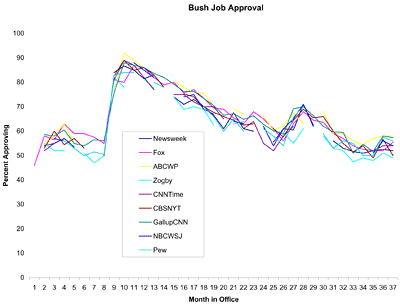
Historical graph of Bush Administration approval ratings

I love this graph, found on PollingReport.com, of Bush’s approval ratings since taking office.  The peaks, of course, correspond to post-9/11 support, the war in Iraq, and a small bump when we captured Saddam in December.  Otherwise, Bush has typically been in gradual decline since taking office.  In other words, without an external event to shore up support, the American people gradually distrust this Administration more and more.  

graph1.gif

So, from the Democratic standpoint, we can expect deficits, internal investigations, and other domestic issues to continue eroding approval ratings into the election season.  Great news.  What we really need to watch for, as many have pointed out, is the Administration pulling a rabbit out of the hat and capturing Bin Laden on Oct 15th or something.  In the latter case, I’d expect the Democrats to be in real trouble.  

More on Pakistan: Khan’s pardon is “conditional”??

Ah…so we find out this morning that Khan’s pardon is “conditional,” rather than a “blanket” pardon.  The AP wire report on this said nothing about whether Khan had been acting with knowledge or even orders from military leadership, including Musharraf.  I still find it difficult to believe the Khan is the top of the heap in terms of deciding to give designs to Iran, Libya, and North Korea.  If Khan acted without the knowledge of the military or other leaders, then the “conditional” pardon makes sense internally, since it would allow them to proceed with prosecution for other wrongdoing.  If, however, Khan is taking the fall and protecting Musharraf and the military leadership, then the “conditional” pardon is just window-dressing for Powell’s visit and the world stage, showing that we’re not completely looking the other way.   

Gen. Wesley Clark and where to go from here

Well, yesterday’s votes in Michigan and Washington pretty much confirmed what we already knew:  along with Dean and Edwards, Clark is pretty much done.  I find this sad, but mostly because I signed onto the Clark Draft pretty early, donated to his campaign several times, and worked on letter writing campaigns to NH and SC.  I respect the man, and think he would have made an excellent president.  Unlike many, I’m not afraid of putting a General in charge.  Those who are afraid that a military man in the White House would unleash further military escapades hasn’t been paying attention.  People who have been in a war tend to learn that war isn’t something to walk into lightly.  Clark, like many who served in Vietnam, appears to understand that sending our troops to die is something that should be done only when necessary, not merely in search of a foreign policy or for public relations.  Clark also appears to understand that leadership doesn’t simply mean doing what you want, and then figuring out how to cover your tracks. 

One or two primaries could be anomalous, but 11 primaries or caucuses are a 22% sample of states (though not population), so it’s increasingly unlikely that the pattern is going to shift.  And Clark needs to get out soon, or risk slipping from “serious but failed contender” to “irrelevant.”  The best strategy for Clark, in my opinion, is to recognize the handwriting, add his support to Kerry, and start working with the front-runner, with the goal of transitioning to a cabinet appointment if Kerry wins.  I have no idea whether Clark is interested in a cabinet post (he seems to be uninterested in the VP role, and isn’t the strongest choice anyway).  

But I think there are a number of positions which could benefit from Clark’s experience.  The most obvious are Secretary of State or Defense.  The problem with Defense, of course, is the tradition which demands nominal civilian control over the military.  Frankly, I think this an overrated objection, for a number of reasons.  First, civilian control of the military is accomplished by having the President serve as the CINC.  SecDef is second in command and part of the National Command Authority, and is subject to an amazing amount of overview, oversight, and guidance by the National Security Council, congressional oversight committees, and the President himself.  Second, numerous SecDef’s have served in the military – often in lower-level officer roles, but occasionally at command and staff levels.  Gen. George C. Marshall, for example, was Army Chief of Staff during WWII, authored the Normandy invasion plan, and coordinated all Allied operations in Europe and the Pacific.   Not to mention that whole “Marshall Plan” thing.   After a stint as SecState under Truman, he was named SecDef in 1953.  

The trend towards civilian Secretaries of Defense with no military service is recent, and in many ways reflects the fact that increasingly fewer people have served in the military since the advent of all-volunteer forces.  At the same time, I would argue that the recent record isn’t all that good.  Which would we rather have, a SecDef with a distinguished military record, or a SecDef who got rich selling the military all of their hardware and intends to continue using the military as a cash cow?  Sound like anybody we know?  And it’s not just Rumsfeld.  Dick Cheney.  Cap Weinberger.  Frank Carlucci. 

But it’s not going to happen, and there’s a better job for Clark anyway.

We would do better to consider Clark for Secretary of State.  There is a tradition of SecState appointees with distinguished military careers, including Colin Powell (say what you want, Powell is a committed internationalist and is deeply uncomfortable with a lot of what’s happened in the last three years.  His recent article in Foreign Affairs must have been written under duress.).  Clark would bring to the job strong experience working with NATO and many UN countries.  He’s respected by many who served with him in NATO, and will be well placed to help repair the damage that’s been done.  Clark would bring credibility to our international relations.  He is the right choice under a Democratic presidency for Secretary of State. 
Tempier 1990 Tourtine (mag)

Opened this at Cafe Campagne with good friends and cassoulet. Incredible nose. Tree bark, brown sugar, sweet nose. Lots of minerals on the palate, deep palate with good acid and length. Some maturity but still plenty of time left. Needs 1+ hour in the decanter to start showing the sweetness of the fruit. Superb, especially with the garlicky sausage in the cassoulet.

So why, exactly, is Pakistan not a “Rogue State” for proliferation of WMD?

Long-time Pakistan watchers were undoubtedly not surprised at the revelations that Pakistani nuclear scientists (including Abdul Khan, the father of that country’s nuclear program) passed designs to Libya, Iran, and North Korea, while maintaining their status as a U.S. ally.  Nor were many of us surprised when Musharraf pardoned Khan, presumably in exchange for Khan covering his superior’s involvement.  That’s par for the course in a country which is alternately run by corrupt military juntas and equally corrupt civilian governments.

Don’t get me wrong, I’ve spent some time in the country and have met many friends and wonderful people.  I have no beef with the people of Pakistan. 

What I find amazing, however, is the utter lack of consistency displayed by the Administration considering our hard-line stance towards state supporters of terrorism and proliferators of WMD.  Or did I miss the memo which redefined the global war on terrorism?  Washington’s reaction to Musharraf’s pardon has been “understated.”  In other words, nothing.  We’re happy that Pakistan is taking care of the problem, and apparently we’re satisfied with their response.  Except for David Kay, of course, who seems to be completely unmanageable and speaks his mind constantly.  I love that guy.  We need ten more guys like Kay and Paul O’Neill, willing to speak the truth even if it gets them in hot water.

As Kevin Drum points out today on this same subject, if you believe the Administration’s position that we should go after state supporters of terrorism and those who proliferate the technologies of WMD, then you should be appalled by the Bush Administration’s response to the pardon.  

Naturally, those of us (likely including Kevin Drum) who view the Administration’s “war on terror” as a public relations campaign first, and a national security strategy second, weren’t surprised a bit.